
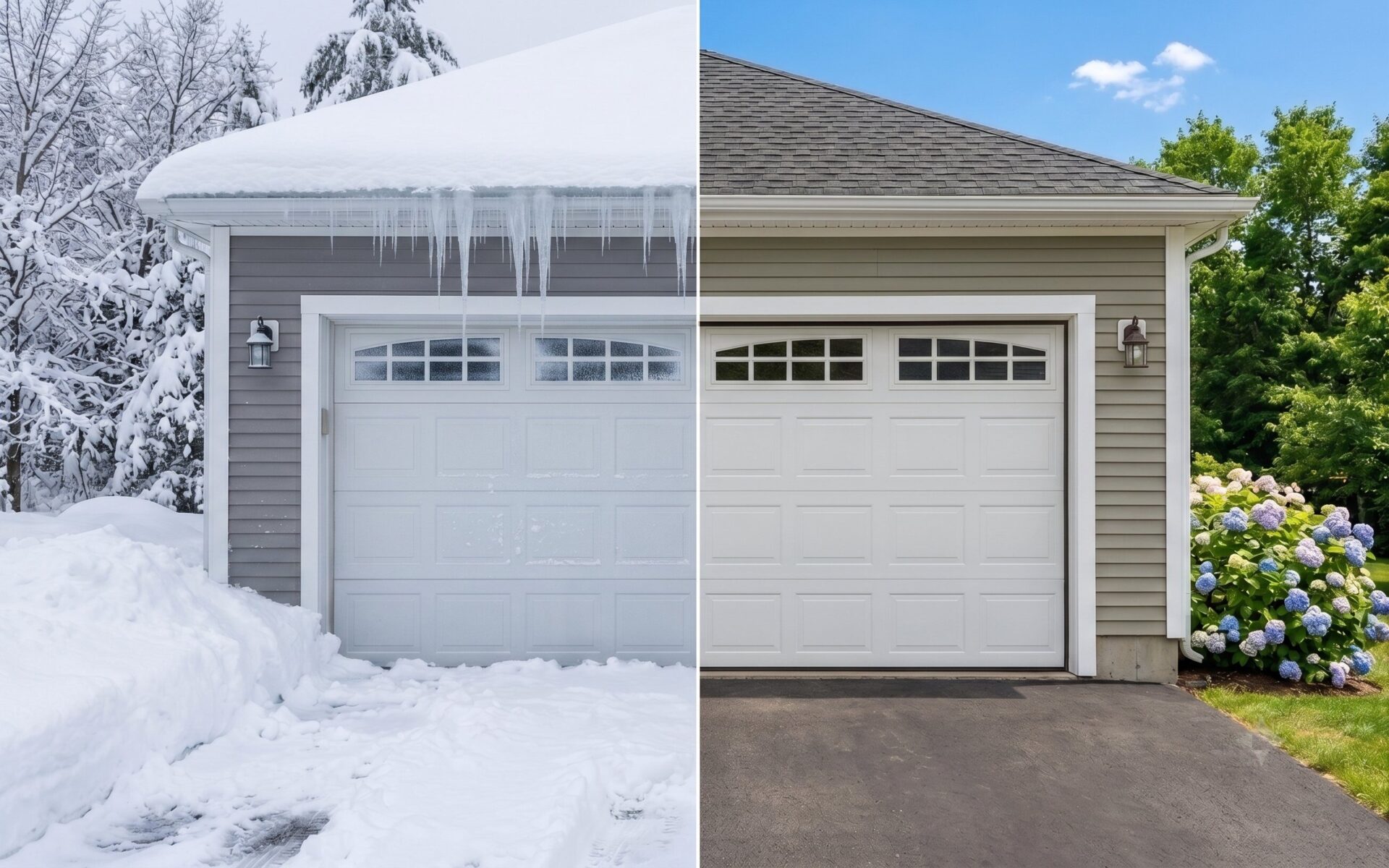
Choosing a garage door in New England is not like choosing one anywhere else. Our region throws everything at a garage door, from sub-zero Vermont winters and ice-laden nor’easters to humid Massachusetts summers and temperature swings that can span 100 degrees over the course of a year.
That means the decision goes far beyond picking a style you like. It is about energy efficiency, structural durability, home security, and long-term value.
At Champion Overhead Door, we have spent decades helping homeowners across Southern Vermont, Southwestern New Hampshire, and Western Massachusetts navigate this exact decision. This guide covers materials, insulation, style, openers, locks, color, and budgeting, so you walk away knowing exactly what to look for and what to avoid.
Why Your Garage Door Choice Matters More in New England
Climate extremes define New England life, and they define garage door performance. Heavy snow loads stress panels and tracks. Freezing rain coats weatherstripping and pries it loose over time. Temperature swings from -10 degrees F to 90 degrees F cause metal to expand and contract repeatedly, weakening hardware and warping poorly constructed panels.
Beyond structural concerns, an uninsulated or poorly sealed garage door acts as a massive energy leak. If your garage is attached to your home, cold air pouring through a thin, single-layer door can drain heat from adjacent living spaces and drive up utility bills all winter long.
The aesthetic stakes are high, too. Your garage door can account for up to 30% of your home’s front-facing exterior. According to Remodeling Magazine’s Cost vs. Value Report, garage door replacement consistently ranks among the top home improvement projects for return on investment, often recouping over 90% of the cost at resale.
Garage Door Materials: Choose Based on Climate Performance First
Material selection is the foundation of every garage door decision. The four primary options are steel, wood, composite, and aluminum. What matters most in New England is how the material performs under climate stress, how much maintenance you are willing to commit to, and what your budget allows.
Steel: The Most Durable Choice for Cold Climates
Steel is the dominant choice for New England homeowners, and for good reason. Modern steel garage doors offer exceptional durability against wind, impact, and temperature extremes. They resist warping and cracking, require minimal maintenance beyond occasional cleaning, and come in a wide range of styles from clean contemporary profiles to traditional raised-panel and carriage-house designs.
The real advantage for our climate is the versatility of insulation. Steel doors come in three configurations:
- Single-layer (steel skin only) for detached storage garages
- Double-layer (steel plus polystyrene insulation) for a solid mid-range option
- Triple-layer (steel on both sides with a polyurethane foam core) for maximum R-value and structural rigidity
Triple-layer doors are what you want when a nor’easter is bearing down. The primary trade-offs are susceptibility to denting and potential rust if the factory finish is scratched and left unrepaired, though modern finishes make these issues manageable.
Wood, Composite, and Aluminum: When They Make Sense
Not every home calls for steel. Depending on your architectural style, location, and priorities, an alternative material may be the better fit:
| Material | Durability | Insulation | Maintenance | Best For |
| Steel | High | Excellent (foam core) | Low | Most New England homes |
| Wood | Moderate | Good | High | Historic or sheltered installs |
| Composite | High | Good to Excellent | Low | Wood look, low upkeep |
| Aluminum/Glass | Moderate | Low | Low | Modern aesthetics, detached |
Insulation and R-Value: A Non-Negotiable in New England
R-value measures a material’s resistance to heat flow. The higher the number, the better the insulation. For garage doors, proper insulation reduces outside noise, adds rigidity and panel strength, and most critically for attached garages, prevents the garage from becoming a giant cold sink that forces your heating system to work overtime.
In Southern Vermont and Southwestern New Hampshire, where winter temperatures routinely drop below zero, an uninsulated garage door is an open invitation for cold air to infiltrate your home. Even in Western Massachusetts, where winters are slightly milder, the energy savings from a well-insulated door pay for themselves within a few seasons.
Match Your Garage Door Style to Your Home’s Architecture
New England is architecturally diverse, and your garage door should complement the character of your home. A carriage-house door that looks perfect on a restored Colonial in Brattleboro might feel completely out of place on a mid-century ranch in Keene. Getting the style right enhances curb appeal and property value. Getting it wrong can diminish both.
Here is a general framework for matching door styles to common New England architecture:
- Colonial and Georgian homes: raised-panel doors with symmetrical window inserts and period-appropriate decorative hardware
- Cape Cod cottages: simple recessed-panel doors with understated window grilles
- Farmhouse and barn-style homes: carriage-house doors with crossbuck or board-and-batten panel designs and wrought-iron hardware
- Mid-century and contemporary homes: flush-panel doors with full-view glass sections or minimalist horizontal lines
Window options range from clear glass to frosted, seeded, or decorative inserts. Insulated glass is available for all styles and is worth the investment in our climate.
At Champion Overhead Door, we offer on-site consultations to help you visualize door styles, panel configurations, and hardware options on your actual home before any purchase commitment is made.
How to Pick the Right Garage Door Color for Your Exterior
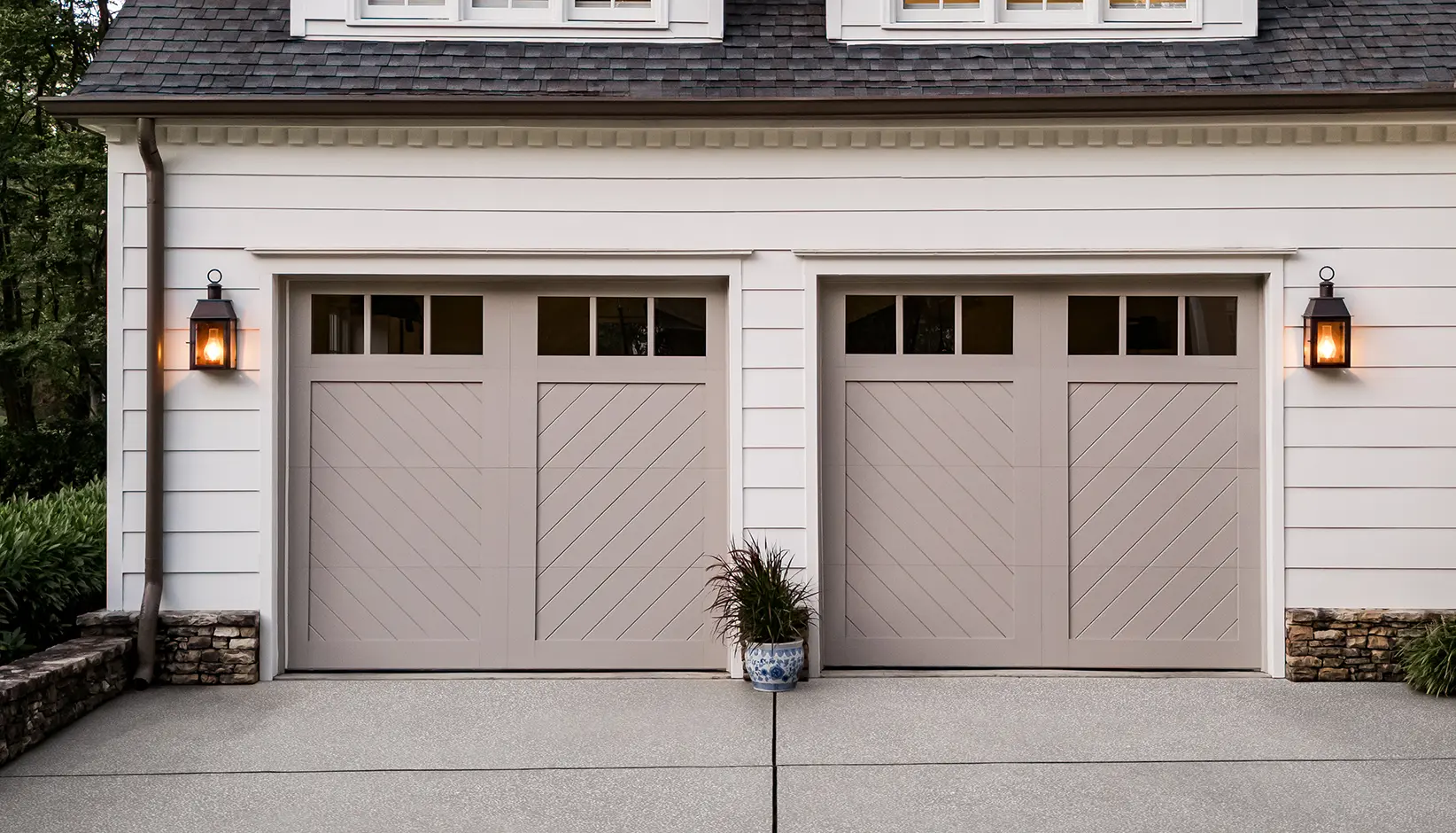
Start with what is already established on your home’s exterior. The most reliable approach is to match the garage door to your trim color for a cohesive look, or coordinate it with your siding for a unified, blended appearance. A contrasting accent color can work, but requires a confident eye.
Practical factors matter in New England. Dark colors absorb more UV radiation and may show fading sooner on south-facing installations. If your home is in a historic district, common in towns like Peterborough, NH or Newfane, VT, check with your local planning board or HOA before ordering.
The five most versatile garage door colors for New England homes:
- White: Timeless and clean, pairs with virtually any exterior palette
- Charcoal: Sophisticated and modern, excellent with lighter siding
- Dark Bronze: Warm and grounding, a natural fit for earth-toned homes
- Forest Green: Classic New England, especially on farmhouse and Colonial styles
- Barn Red: Bold but heritage-appropriate, particularly in rural Vermont and New Hampshire
Most major manufacturers offer color-matching programs, allowing us to help you customize beyond standard options, ensuring a precise fit with your home’s exterior.
How to Choose a Garage Door Opener That Handles the Cold
The opener is the mechanical heart of your garage door system, and cold weather is its toughest test. When temperatures plummet, lubricants thicken, metal components contract, and motors strain against doors that feel heavier due to cold-stiffened springs and frozen weatherstripping.
Beyond cold-weather durability, today’s openers offer smart-home connectivity, battery backup, and safety features that were unimaginable a decade ago. Balancing drive type, power, features, and budget against the specific demands of our climate is what separates the right opener from the wrong one.
Belt Drive, Chain Drive, or Screw Drive: Which Is Right for You?
The drive mechanism is your first decision. Here is how the three types compare:
| Drive Type | Noise Level | Best For | Key Trade-Off |
| Belt Drive | Quiet | Attached garages with living space above or beside | Costs slightly more than chain drive |
| Chain Drive | Louder | Detached garages where noise is not a concern | Most affordable, very durable |
| Screw Drive | Moderate | Various applications | Fewer moving parts, less maintenance |
For most New England homeowners with attached garages, a belt drive opener is the best all-around choice. It is quiet enough for daily use, reliable in cold weather, and compatible with smart-home features.
Garage Door Security: Locks and Safety Features You Need
Your garage door is one of the largest entry points to your home. Security should factor into every decision, from the lock you choose to the safety mechanisms built into the system.
Choose the Lock Type That Fits Your Setup
- Manual slide locks: A steel bar slides from the door into a track on either side, physically preventing the door from being lifted. Effective as a backup, especially for vacation homes or seasonal properties, but can only be engaged from inside the garage.
- T-handle locks with keyed entry: Mount on the exterior and allow you to lock and unlock from outside using a key. Standard on doors without automatic openers and reliable for no-frills security.
- Electronic and smart lock integration: Many modern openers feature rolling-code technology that changes the access code with every use, making it virtually impossible for someone to duplicate your signal. Smart openers let you set unique access codes for family members or contractors and revoke them anytime.
Safety Features Required by Code
- Auto-reverse sensors detect objects in the door’s path and reverse the door before contact
- Manual release handles allow you to disconnect the opener and operate the door by hand during power outages
- Tamper-resistant brackets on the bottom fixtures prevent the high-tension cable system from becoming a hazard if a panel is removed
We ensure every installation meets current safety standards and local building codes, giving you confidence that your system is as safe as it is secure.
What to Budget for a New Garage Door in New England
Garage door costs vary based on size, material, insulation, style, and features. Here is a realistic framework for understanding where your investment goes:
| Tier | What You Get | Best For |
| Entry-Level | Single-layer steel, no windows, minimal insulation. Lowest upfront cost. | Detached garages used strictly for storage. |
| Mid-Range | Insulated steel (double or triple layer) with window inserts. Solid thermal performance, good curb appeal, and long-term durability. | Most New England homeowners. Best cost-per-year of ownership when you factor in energy savings and longevity. |
| Premium | Carriage-house designs, wood composite, or custom configurations. Highest curb appeal, best insulation values, most design flexibility. | Homeowners focused on aesthetics and long-term home value. |
One of the most common mistakes we see is choosing the cheapest option for an attached garage. The energy loss through a poorly insulated door, combined with earlier replacement needs, often makes the budget door the most expensive choice over a 15 to 20-year period.
We provide free, no-obligation estimates across our entire service area in Southern Vermont, Southwestern New Hampshire, and Western Massachusetts.
Frequently Asked Questions
What type of garage door is best for cold weather?
Insulated steel doors with polyurethane foam cores are the best choice for cold climates. Look for an R-value of at least R-12 for attached garages. The insulation keeps your garage warmer, reduces energy costs, and adds rigidity to the panels so they hold up better against wind and snow.
How do I know what size garage door I need?
Standard single garage doors are 8 or 9 feet wide and 7 feet tall. Double garage doors are typically 16 feet wide. However, older New England homes sometimes have non-standard openings, so measure the width, height, headroom, and side room before ordering. Alternatively, our professional installers can take exact measurements during your free estimate.
Does garage door color affect energy efficiency?
Slightly. Darker colors absorb more heat from sunlight, which can be a small benefit in winter but may cause more expansion in summer. However, insulation quality and weatherstripping have a far greater impact on energy efficiency than color. Choose your color based on aesthetics and let insulation do the heavy lifting.
How long does a garage door typically last?
A well-maintained steel garage door can last 15 to 30 years. Wood doors may need refinishing every few years and have a shorter functional lifespan without consistent upkeep. The opener typically lasts 10 to 15 years. Regular maintenance including lubrication, spring inspection, and weatherstrip replacement extends the life of the entire system.
Is it worth getting a garage door with windows?
Windows add natural light, especially valuable during New England’s shorter winter days. Insulated glass options prevent significant heat loss. Keep in mind that windows reduce privacy, so consider frosted or obscured glass if your garage faces the street or neighbors.
Should I install my own garage door or hire a professional?
Garage door installation involves high-tension springs that can cause serious injury if handled incorrectly. Our professional installation also ensures proper balancing, weather sealing, and code-compliant safety features. For safety and warranty protection, we strongly recommend trusting our experienced team to handle the installation.
Ready to Find the Right Garage Door for Your Home?
Choosing a garage door means balancing climate performance, architectural style, security, energy efficiency, and budget all at once. There is no substitute for professional guidance tailored to your specific home and situation.
At Champion Overhead Door we offer free, personalized consultations. Our team will visit your home, assess your needs, take precise measurements, and walk you through the products and features that make the most sense for your property.
No pressure. No obligation. Just honest, expert advice from a team that knows New England garage doors inside and out.
Contact us today to schedule your free garage door consultation.